U.S. Patent Applications
Top Clamshell Packaging Manufacturers for Global Buyers
Global buyers are rethinking how fresh produce reaches store shelves. Produce clamshell packaging now protects berries, tomatoes, herbs, and delicate specialty crops during handling. It also shapes shelf visibility, ventilation, stacking, and consumer trust.
Industry reports show why supplier selection matters. Smithers’ The Future of Global Plastic Packaging to 2028 identifies food packaging as a major demand sector, while PMMI’s Packaging Compass reports continuing investment in automation, material efficiency, and recyclable formats. Grand View Research also reports steady growth in the global clamshell packaging market, although market definitions vary between studies. That difference deserves attention. Forecasts can look precise, yet they may measure different products, regions, and material types.
Walter Soroka, author of Fundamentals of Packaging Technology, describes packaging as “a system of preparing goods for transport, distribution, storage, retailing, and end-use.” His definition remains practical. A clamshell is not merely a clear plastic box. It is a small logistics system with hinges, seals, airflow, labels, and handling requirements.
The manufacturers featured in this guide are assessed through production capacity, material options, tooling experience, quality controls, export readiness, and customization support. Details matter. A weak hinge can open inside a carton. Poor vent placement can accelerate condensation. An attractive design may still waste material or damage fragile produce.
No supplier is perfect. Buyers should verify certifications, test samples, and compare total landed cost before signing contracts. The strongest partner balances protection, presentation, production consistency, and measurable environmental progress.
What Clamshell Packaging Is and Why Global Buyers Use It
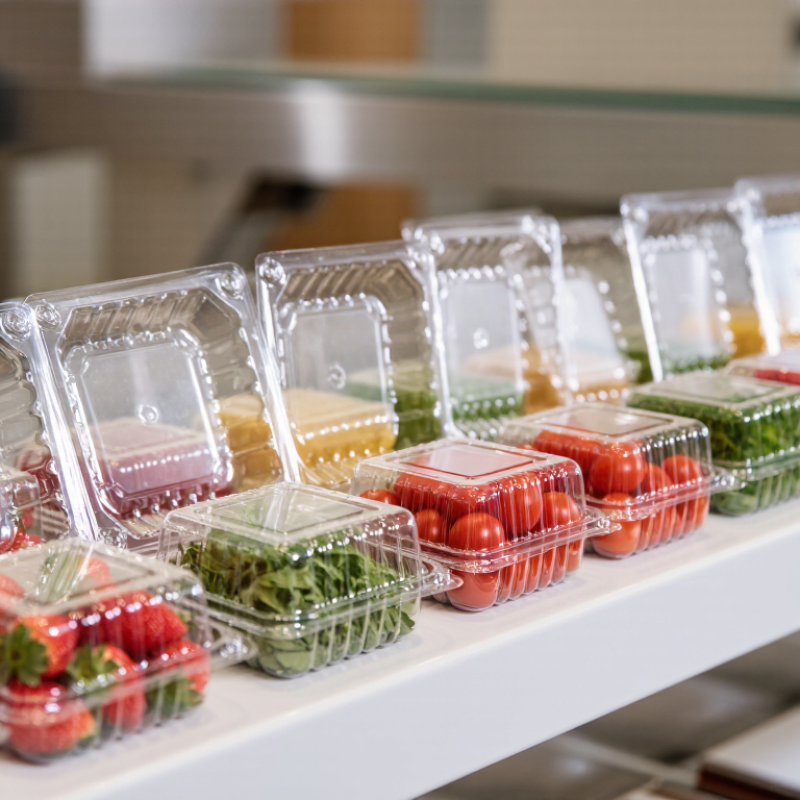
Clamshell packaging is a clear container with two hinged halves that close around a product. Manufacturers usually form it from PET, recycled PET, or other approved plastics. The front and back sections create a protective shell. Heat sealing or mechanical locking keeps the package closed during handling. Some designs include a hanging tab for retail displays. Others use a flat base for shelves and shipping cartons.
Global buyers use clamshells because the product remains visible before purchase. Retail staff can identify missing parts without opening every package. Shoppers can inspect color, size, and surface condition quickly. The rigid shell also reduces crushing, dust, and casual handling damage. For exporters, consistent dimensions help improve carton planning and warehouse storage. That matters when goods travel through several climates and transport systems. Clamshells are practical, but not perfect.
Experienced buyers should examine more than appearance. Ask manufacturers for material specifications, closure samples, and production tolerances. Test the package with the actual product, not an empty sample. Check whether sharp edges, trapped moisture, or excessive plastic affect usability. A clear package may show the product well, yet still create glare under store lighting. Hinge fatigue can appear after repeated opening. Small details matter. Buyers should also request drop and vibration testing for long-distance shipments. Recycling compatibility requires careful review because labels, coatings, and mixed materials may complicate sorting. A lower unit price can become expensive after damaged goods, slow packing, or rejected shipments.
Key Criteria for Evaluating Clamshell Packaging Manufacturers
Top Clamshell Packaging Manufacturers for Global Buyers
When evaluating clamshell packaging manufacturers, buyers should inspect more than unit price. Fortune Business Insights estimated the global clamshell packaging market at about US$7.4 billion in 2023. That scale increases pressure on quality, capacity, and delivery accuracy. Ask for documented seal-strength results, drop-test records, and dimensional tolerances. A reliable supplier should explain tooling lead times and provide production samples before approval. Small variations can cause retail hooks to sit unevenly.
Material selection also requires evidence. The Ellen MacArthur Foundation reports that only about 9% of plastic waste is recycled globally. Therefore, ask whether the clamshell uses a clearly identified polymer and compatible recycled content. Request migration testing for food-contact applications when relevant. Check whether the material performs well under heat, cold, and transport vibration. Recyclability claims can sound impressive. They are not always practical in local systems. I have seen specifications that looked sustainable but failed during sealing trials.
Tips: Compare at least three suppliers using the same test conditions. Review monthly defect rates, not only sample quality. Confirm third-party certifications and audit dates. Ask for a corrective-action record. A manufacturer that admits occasional failures may be more credible than one promising perfection. Also verify backup capacity, inspection procedures, and communication speed across time zones. A low quotation is useful only when the delivered package remains consistent.
Major Types of Clamshell Packaging Suppliers and Their Capabilities
Clamshell suppliers usually fall into three groups: thermoformers, injection molders, and integrated packaging converters.
Thermoformers heat PET, RPET, PVC, or polypropylene sheets, then shape them over precision tooling. They suit retail packs, blister-style displays, and short development cycles.
Injection molders create thicker, rigid shells with consistent walls and strong hinge details. Their tooling costs are higher, but dimensional control is often better.
Integrated converters add printing, labeling, sealing, assembly, and logistics. This matters when buyers need finished packs rather than empty shells.
Smithers’ The Future of Global Packaging to 2028 estimates the global packaging market reached approximately $1.2 trillion in 2023. Grand View Research also identifies thermoformed packaging as a major growth segment, supported by food, electronics, and healthcare demand. These figures show scale, not guaranteed supplier quality. A supplier may claim broad capability, yet lack suitable recycled-content processing or reliable sealing equipment.
Tips:
Ask for material certificates, sample packs, mold-flow evidence, and recent production data. Check hinge fatigue, seal strength, stacking performance, and clarity under real conditions. Confirm whether the quoted tooling includes revisions. It often does not. Request pilot-run results before approving mass production. Review scrap rates and inspection methods, too. A lower unit price can hide unstable forming, weak closures, or excessive trimming waste. Supplier selection should match the required annual volume, cavity count, automation level, and destination-market packaging rules.
How to Compare Materials, Customization, Quality, and Compliance
When comparing clamshell packaging manufacturers, begin with the material, not the catalog image. PET offers clear display and reliable toughness, while recycled PET can support sustainability goals. PVC may suit some applications, but buyers should check regional restrictions and disposal conditions. PP handles heat better in many formats, yet its clarity and hinge behavior vary by grade. Ask for resin data, thickness tolerances, and samples from the actual production line. A polished sample can hide inconsistency.
Customization should be measured beyond color and logo placement. Review cavity dimensions, hinge strength, hanging holes, sealing method, and opening force. A supplier should provide drawings with tolerances, not only attractive digital renders. Request a trial run with your product inside. Check whether edges crush during stacking and whether labels wrinkle on curved surfaces. Small details matter. I once found that a perfect fit slowed packing because operators struggled to close the tabs. That weakness was not visible in the prototype.
Quality assessment needs documented controls. Look for incoming material checks, mold maintenance records, seal testing, and batch traceability. Ask how defects are sampled and how corrective actions are recorded. Compliance requires more than a familiar certificate. Confirm food-contact suitability when relevant, restricted-substance declarations, recycling marks, and destination-market packaging rules. Independent test reports can strengthen confidence, but verify their scope and date. No comparison is perfect. Recheck assumptions when the order size, climate, or shipping route changes.
Top Clamshell Packaging Manufacturers for Global Buyers
Comparing materials, customization, quality consistency, and compliance readiness helps global buyers evaluate clamshell packaging suppliers more objectively. The chart uses a transparent 1–5 procurement benchmark, where 5 represents the strongest typical suitability for international sourcing.
PET and rPET typically provide strong clarity and recycling alignment, PP offers good chemical resistance and heat performance, while PVC can support cost-effective production but may face stricter sustainability and compliance requirements in some markets. Actual results depend on product specifications, tooling, testing, and destination-country regulations.
Steps for Selecting a Reliable Clamshell Packaging Manufacturer
Top Clamshell Packaging Manufacturers for Global Buyers
Selecting a reliable clamshell packaging manufacturer requires more than comparing unit prices. Begin by checking production experience, material expertise, and export performance. Request recent samples, not only polished catalog images. Inspect hinge strength, sealing consistency, edge safety, and barcode visibility. A useful supplier should explain its forming temperature, tooling tolerance, and quality-control process in clear language.
Industry data can guide this review. Smithers reports continued growth in rigid plastic packaging, driven by convenience, product visibility, and protective performance. The Association of Plastic Recyclers also stresses that packaging design affects recycling outcomes. Ask manufacturers whether they offer PET or recycled-content options, and request material certificates. ISO 9001 certification can support reliability, but it does not replace factory audits. Visit the plant when possible. Look closely at storage areas and inspection records.
Tip: Compare total landed cost, not the quoted factory price. Include tooling, freight, testing, duties, and expected defect rates. Ask for a pilot order with measurable acceptance criteria. Check lead times during peak production periods. A supplier promising everything immediately may deserve more questions. Also review communication habits: slow answers before the contract rarely improve afterward. No checklist is perfect. I would still test the package under compression, vibration, heat, and repeated handling. Real shipping conditions often reveal weaknesses that a clean sample hides.
Top Clamshell Packaging Manufacturers for Global Buyers - Steps for Selecting a Reliable Clamshell Packaging Manufacturer
Use this manufacturer-selection matrix to compare qualified suppliers without relying on brand names. Target values are practical industry benchmarks and should be confirmed against the product, market, material, and applicable regulations.
| Selection Dimension | What to Check | Practical Benchmark or Data Point | Verification Evidence | Buyer Importance |
|---|---|---|---|---|
| Material Capability | Ability to process transparent and recycled-content sheet materials suitable for the intended application. | Common options include PET, rPET, PVC, PP, and PLA. The material should match the required clarity, stiffness, heat resistance, recyclability, and end-market regulations. | Material technical data sheet, resin identification, recycled-content declaration, and sample approval. | High |
| Material Thickness | Whether the supplier can maintain consistent sheet thickness throughout the formed package. | Typical rigid clamshell sheet thickness is approximately 0.30–0.80 mm, depending on product weight, cavity depth, hinge design, and stacking requirements. | Approved drawing, thickness-tolerance specification, and inspection report from production samples. | High |
| Dimensional Accuracy | Control of overall length, width, height, cavity dimensions, and closure alignment. | A written dimensional tolerance is essential; many projects begin with a tolerance range around ±0.20–0.50 mm for critical formed dimensions, subject to tooling and design review. | 2D engineering drawing, first-article inspection report, calibrated measuring equipment, and approved golden sample. | High |
| Product Protection | Resistance to impact, compression, puncture, scuffing, and accidental opening during distribution. | The package should pass product-specific drop, compression, vibration, and opening-force tests defined before mass production. | Test plan, test conditions, pass/fail criteria, and laboratory or in-house test records. | High |
| Hinge and Closure Design | Repeated hinge movement, locking strength, tamper resistance, and ease of opening. | The hinge and snap closure should be tested for repeated opening and closing cycles appropriate to the product. Closure performance must remain stable after transport and temperature exposure. | Cycle-test results, closure-force measurement, sample evaluation, and user-opening assessment. | High |
| Sealing Options | Availability of heat sealing, ultrasonic sealing, RF sealing, adhesive sealing, or mechanical locking. | The selected process should provide a continuous seal or secure lock without damaging the product. Sealing conditions should be documented by temperature, pressure, dwell time, or energy. | Process specification, seal-strength test, equipment capability list, and production sample. | High |
| Food-Contact Compliance | Suitability for direct or indirect contact with food, cosmetics, medical products, or other regulated goods. | For the destination market, documentation may include applicable food-contact declarations, migration testing, and compliance with relevant regional regulations. Compliance depends on the complete packaging structure, not only the base resin. | Declaration of compliance, migration-test report, formulation statement, and traceability records. | High |
| Quality Management | Formal control of incoming materials, forming, trimming, printing, assembly, and final inspection. | An ISO 9001-certified quality management system is a useful baseline, but certification does not replace product-specific quality inspection and corrective-action controls. | Current certificate, quality manual summary, inspection plan, nonconformance procedure, and recent audit records. | High |
| Tooling and Engineering | Design-for-manufacturing support, mold construction, cavity balancing, draft angles, and prototype development. | The supplier should review wall distribution, draft, radii, hinge geometry, trimming access, nesting, and ejection before approving the tool design. | DFM review, 3D model, 2D drawing, prototype report, tooling ownership terms, and tool-maintenance plan. | High |
| Prototype and Sampling | Ability to provide functional samples before production tooling or mass production. | A reliable approval sequence normally includes design review, prototype or soft-tool sample, production-tool trial, dimensional approval, and signed pre-production sample. | Sample schedule, sample measurements, change history, approval form, and retained reference sample. | High |
| Print and Decoration | Control of offset, screen, digital, or in-mold decoration processes on curved or transparent surfaces. | Color approval should use a defined reference standard and viewing condition. Critical graphics require registration, adhesion, abrasion, and rub testing. | Color standard, artwork proof, ink compliance documents, adhesion test, and production inspection criteria. | Medium |
| Recycled Content | Availability and traceability of post-consumer or post-industrial recycled resin. | The buyer should specify the required recycled-content percentage by mass. Actual performance can vary because recycled resin may affect clarity, color, odor, and mechanical properties. | Supplier declaration, chain-of-custody records, recycled-content certificate, and batch traceability. | High |
| Recyclability | Compatibility of the final package with collection and recycling systems in the destination market. | A mono-material design is generally easier to sort and recycle than a structure combining incompatible plastics, permanent metal parts, or inseparable labels and coatings. | Material composition, component list, recycling assessment, label specification, and destination-market guidance. | High |
| Production Capacity | Available forming lines, trimming equipment, sealing capacity, shifts, and backup production resources. | Capacity should be stated as verified output per shift or per month for the exact package type, rather than as a general factory maximum. | Capacity calculation, equipment list, production schedule, utilization data, and contingency plan. | High |
| Minimum Order Quantity | Minimum order requirements for tooling, production, printing, and material purchasing. | MOQ is project-specific and commonly changes with material grade, color, decoration, tooling, and production setup. A written quotation should separate tooling quantity from repeat-order quantity. | Formal quotation, MOQ schedule, setup-cost breakdown, and small-batch policy. | Medium |
| Lead Time | Time required for design approval, tooling, sampling, production, inspection, and shipment preparation. | A realistic schedule should identify each stage separately. Tooling and sample lead times must not be presented as the same period as repeat-production lead time. | Milestone schedule, critical-path plan, production slot confirmation, and delay-escalation procedure. | High |
| Traceability | Ability to trace resin, production date, machine, operator, inspection result, and shipment lot. | Each shipment should have a lot or batch identifier linked to material records, production records, inspection results, and retained samples. | Batch coding system, lot records, certificate of analysis, inspection report, and retention policy. | High |
| Packaging for Export | Protection against deformation, moisture, dust, crushing, and transit movement. | Export cartons should specify inner quantity, carton dimensions, gross weight, stacking limits, and pallet configuration. Packaging should be tested for the expected transport route. | Packing specification, carton drop test, pallet diagram, shipping marks, and loading photographs. | Medium |
| Commercial Transparency | Clarity of pricing, tooling ownership, payment terms, warranty limits, inspection rights, and change-control process. | The quotation should separately identify material, tooling, printing, sealing, inspection, packaging, freight assumptions, and any recurring charges. | Signed quotation, purchase agreement, tooling clause, quality agreement, and approved change-order procedure. | High |
| Supplier Scorecard | Structured comparison of shortlisted manufacturers using consistent weights. | A practical scoring model can assign 30% to quality and compliance, 20% to product performance, 15% to engineering and tooling, 15% to capacity and lead time, 10% to total cost, and 10% to sustainability and communication. | Completed supplier questionnaire, sample scorecard, audit findings, corrective-action status, and final approval record. | High |
Related Posts
-
2026 Best Clamshell Packaging Solutions for Sustainable Packaging Needs?
-
Top 10 Benefits of Using Small Clamshell Containers for Food Storage?
-

Top 10 Clamshell Packaging Suppliers Canada Global Buyers?
-
How to Choose Clear Clamshell Packaging for Your Products?
-
2026 Top Clamshell Packaging Wholesale Trends and Innovations?
-

Why Choose Plastic Clamshell Packaging for Global Shipping?