U.S. Patent Applications
Why Choose Jumbo Egg Cartons for Global Egg Packaging?
Global egg packaging must protect product quality from the farm to the retail shelf. Jumbo egg cartons are designed for larger eggs, stronger cushioning, and more stable presentation during transport. Their deeper cups can reduce shell contact with carton walls, especially when trucks travel over uneven roads. That detail matters. A single cracked egg can affect customer trust, shipment value, and retailer relationships.
Experienced packers evaluate more than carton size. They examine pulp strength, moisture resistance, ventilation, stacking performance, and compatibility with automated filling lines. Recycled fiber cartons may offer a practical balance between protection and sustainability, while plastic formats can provide visibility and consistent hygiene control. The right choice depends on climate, handling distance, equipment, and local food-packaging requirements. One solution rarely fits every market.
Jumbo egg cartons also support clearer product communication. Larger labels can show grade information, pack dates, storage guidance, and traceability details without crowding the lid. Retail buyers often value cartons that stack neatly and remain readable after refrigeration. However, larger cartons may require more storage space and higher material use. That trade-off deserves honest testing. A carton that looks efficient in a warehouse may perform poorly on a busy packing line. Careful trials, supplier documentation, and feedback from growers, distributors, and retailers help confirm whether jumbo egg cartons deliver reliable value across global supply chains. No packaging decision should rely on appearance alone.
What Are Jumbo Egg Cartons?
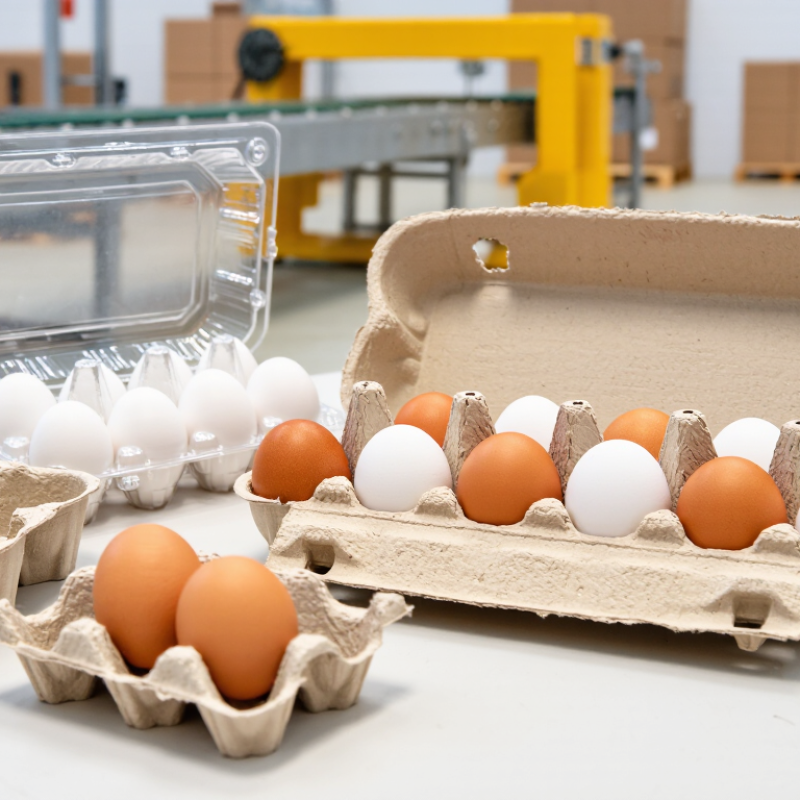
Jumbo egg cartons are larger protective packs designed to hold more eggs than standard cartons. Their capacity may include 18, 24, or 30 eggs, depending on regional standards and carton design. “Jumbo” does not always mean jumbo-sized eggs. It usually describes the carton’s volume or holding capacity.
A well-designed carton separates each egg with molded cups and raised dividers. These structures help reduce contact, shifting, and shell damage during storage and transport. Many cartons use molded fiber because it is light, stackable, and suitable for recycling systems where accepted.
Ventilation openings can also support airflow, especially when cartons move through warm warehouses. Still, bigger is not automatically better. An oversized carton may waste space if the eggs fit loosely.
Tips: Check the egg diameter, carton depth, stacking strength, and closure before placing a large order. Test cartons on the real packing line. Small gaps can become costly problems. Also review local labeling, recycling, and food-contact requirements, since packaging rules differ across markets. A practical trial with filled cartons often reveals weaknesses that drawings miss.
How Jumbo Egg Cartons Support Global Egg Packaging
Jumbo egg cartons support global egg packaging by combining capacity, protection, and handling efficiency. FAOSTAT reports that global hen-egg production exceeded 90 million tonnes in 2022. Such volume requires packaging that performs across farms, warehouses, ports, and retail shelves. Jumbo formats hold more eggs per unit, reducing carton counts and handling touches. Fewer touches can lower labor pressure and carton waste.
Protection remains critical. The International Egg Commission notes that eggs are among the world’s most widely consumed animal proteins. Their fragile shells demand stable cavities, firm dividers, and consistent stacking strength. A well-designed jumbo carton keeps eggs separated during vibration and short-distance impacts. In practice, packers should test filled cartons on pallets, not only inspect empty samples. Small design flaws become expensive during long transport.
Room for improvement remains. Larger cartons may create unused space when demand varies. They can also become awkward for smaller retailers or older consumers. Moisture, compression, and temperature changes deserve closer testing in export routes. The Food and Agriculture Organization emphasizes resilient food systems, but packaging decisions still require local evidence. A jumbo carton works best when its size matches egg grading, pallet dimensions, warehouse equipment, and consumer habits. One format cannot solve every market.
Key Materials and Protective Design Features
Jumbo eggs need more than extra cavity space. Their weight and larger shell surface increase pressure during stacking and transport. A suitable carton begins with molded fiber, recycled paperboard, or carefully selected plastic. Molded fiber absorbs small impacts and offers a textured grip. Recycled paperboard can be strong, but moisture may reduce its stiffness. Test it cold.
Protective design should keep each egg in an individual pocket. Deep cells, rounded dividers, and raised points limit shell-to-shell contact. For jumbo formats, thicker rims help distribute compression across the lid and base. A firm locking tab prevents the lid from lifting during pallet movement. Small vents can reduce condensation when chilled cartons enter warmer rooms. Too many vents, however, may weaken the structure. Fit matters most.
Reliable packaging teams measure compression, vibration, drop resistance, and closure strength before production. They also inspect cartons after refrigerated storage, where damp fibers can soften and deform. Clear cavity dimensions reduce rocking on conveyor belts and during manual handling. A practical carton should open without twisting the eggs. This detail is often overlooked. Material selection must consider recycling access, food-contact requirements, and regional shipping conditions. A stronger carton is not automatically better; excess material can raise cost and waste. No design is perfect.
Why Choose Jumbo Egg Cartons for Global Egg Packaging?
Jumbo eggs require more internal clearance and stronger cushioning than smaller egg classes. Molded-fiber cartons are commonly selected for their rigidity, cushioning cells, ventilation, and recyclable fiber construction.
Chart metric: Minimum net weight per dozen, measured in ounces. Jumbo eggs have the highest standardized weight requirement, increasing the need for correctly sized pockets, reinforced dividers, and secure closures.
Reference: United States Department of Agriculture, United States Standards, Grades, and Weight Classes for Shell Eggs.
Benefits for Transport, Storage, and Retail Display
Jumbo egg cartons are built for larger eggs, but their value extends beyond capacity. In practical packing operations, a correctly sized carton reduces shell movement during handling. Less movement can mean fewer cracks when cases travel over uneven roads. The fit must be tested, not guessed. Eggs vary more than many teams expect.
For transport, a strong carton needs stable cells, a secure closure, and predictable stacking. Cartons that compress under top loads may damage eggs below. Moisture also matters, especially in chilled rooms or humid loading areas. Molded fiber can absorb humidity, while some plastic formats tolerate repeated condensation better. Neither option is perfect. Packaging teams should check compression strength, ventilation, and temperature exposure with actual cases before global shipment.
Storage becomes easier when jumbo cartons keep a uniform footprint. Pallets can be stacked with fewer gaps, improving space use and reducing leaning. In retail displays, the larger format gives shoppers clear visibility of egg size and count. A flat lid also supports readable dates and handling instructions.
Yet oversized packs may be harder for some customers to lift. Display planning should consider shelf depth, hand reach, and replenishment speed.
A short trial often reveals problems that a specification sheet misses.
Sustainability and Selection Considerations for International Markets
Jumbo egg cartons support international shipments when larger eggs need stable spacing and stronger protection. FAOSTAT records global hen egg production above 90 million tonnes in recent years. That scale makes packaging choices commercially significant. A carton should hold each egg firmly, limit movement, and survive stacking during refrigerated transport. Size standards also vary between markets. “Jumbo” does not always mean the same weight everywhere.
Sustainability requires more than choosing paper over plastic. The OECD Global Plastics Outlook (2022) reported that only 9% of global plastic waste was recycled. Molded-fiber cartons can use recycled paper and offer easier recovery in many regions. However, fiber may weaken after absorbing condensation. That matters inside cold trucks and humid warehouses. Recycled content can also reduce stiffness if poorly engineered. A practical design may need moisture-resistant treatment, but that treatment can complicate recycling.
Selection should combine lifecycle evidence, local recycling access, and transport performance. The UNEP Turning off the Tap report (2023) found that global plastic pollution could be reduced by 80% by 2040 through system changes. Packaging buyers should request verified recycled-content data, compression testing, and food-contact documentation. Carton dimensions should match pallet patterns, not only egg size. Small gaps create breakage. Oversized cartons waste space. I have seen sustainability claims fail when damaged cartons required repacking. That lesson deserves attention. Lower material use is not automatically better if product loss increases.
| Selection Dimension | Reference Data or Common Industry Range | Why It Matters for Jumbo Egg Cartons | International Market Consideration | Recommended Decision Check |
|---|---|---|---|---|
| Egg Capacity | Common retail formats include 6, 10, 12, 15 and 18 eggs. Commercial trays commonly hold 20, 30 or 36 eggs. | Jumbo cartons can support larger eggs while maintaining individual pockets and impact protection. | Retail pack sizes differ by country, retailer format and household purchasing habits. | Match the carton count with local retail standards and consumer demand. |
| Jumbo Egg Size | In the United States, a jumbo egg size is defined by an average minimum weight of 30 ounces per dozen, or approximately 56.7 grams per egg. Egg-size classifications vary internationally. | A larger egg may require deeper or wider pockets than a standard carton to reduce shell contact and cracking. | Do not transfer one country’s egg-size definition directly to another market. | Confirm egg dimensions and weight classifications in the destination country before tooling. |
| Molded Pulp Construction | Usually manufactured from recycled paper fibers and formed into protective pockets. It is generally recyclable where local paper-recycling systems accept the material. | Provides cushioning, ventilation and good surface adhesion for labels or printed information. | Recycling and composting rules differ by municipality; food contamination can affect acceptance. | Use recycled fiber when available and verify local collection requirements. |
| Plastic Construction | PET cartons can be transparent and may contain recycled PET. Recyclability depends on the polymer, local collection and sorting infrastructure. | Offers moisture resistance, product visibility and consistent dimensions for automated handling. | Clear plastic may improve product inspection, but packaging fees and recycling rules vary by market. | Confirm the accepted polymer type and recycled-content regulations in each destination. |
| Expanded Polystyrene | Lightweight and protective, but collection and recycling are restricted or unavailable in many regions. | Can provide strong cushioning but may create greater end-of-life challenges. | Some jurisdictions restrict or discourage food-service and retail packaging made from expanded polystyrene. | Avoid this material where local legislation or collection systems create compliance risks. |
| Protection During Transport | Egg cartons use separated pockets to reduce egg-to-egg contact. Carton performance depends on fiber strength, geometry, closure and stacking. | Jumbo eggs have greater volume and can experience higher contact pressure if the carton is undersized. | Longer international routes may involve vibration, compression, humidity changes and temperature variation. | Conduct drop, compression, vibration and humidity testing using the filled carton. |
| Ventilation and Moisture | Molded-fiber cartons are breathable, while plastic formats provide greater resistance to external moisture. | Ventilation helps manage condensation, but excessive moisture can weaken paper-based cartons. | Climate, cold-chain practices and warehouse conditions vary substantially between export markets. | Choose the material and coating according to route climate, storage duration and refrigeration conditions. |
| Packaging Weight | Packaging weight depends on capacity, material, wall thickness, closures and labeling. No single weight applies to all jumbo carton designs. | Lower packaging weight can reduce transport emissions, but excessive material reduction may weaken protection. | Freight calculations should include the carton, eggs, secondary packaging and pallet configuration. | Optimize packaging weight only after protection and stacking tests are passed. |
| Space Efficiency | Standardized footprints and interlocking or stackable designs can improve pallet utilization. | Efficient nesting and stacking help reduce unused volume and the number of transport units. | Container dimensions, pallet standards and warehouse equipment differ between regions. | Measure filled-carton cube utilization for the target pallet and shipping-container format. |
| Labeling and Traceability | Market requirements may include egg grade, size, quantity, lot identification, packing date, best-before date, storage guidance and origin information. | A larger carton provides more usable surface area for mandatory information and handling symbols. | Language, allergen, date-format, barcode and traceability requirements are market-specific. | Obtain current labeling requirements from the destination-market regulator or importer. |
| Food-Contact Compliance | Paper, pulp, plastic, inks, coatings and adhesives must be suitable for the intended food-contact application. | Material safety is as important as carton strength because the package contacts the shell and may be used in refrigerated conditions. | Food-contact rules and documentation requirements differ among jurisdictions. | Request supplier declarations, migration testing and applicable compliance documentation. |
| Sustainability Evidence | Relevant indicators include recycled content, renewable-fiber content, packaging weight, recycled volume, recyclability and transport efficiency. | A carton should be evaluated across its full life cycle rather than by material type alone. | Environmental claims may require substantiation and may be regulated differently across markets. | Use documented, market-relevant claims and avoid unsupported terms such as “100% sustainable.” |
| Best-Fit Application | Jumbo cartons are most suitable when large eggs, stronger protection, clear size differentiation or export handling justify the additional design requirements. | They can reduce cracking risk when correctly matched to the egg profile and supply chain. | A standard carton may be more efficient if the destination market does not recognize or purchase jumbo eggs. | Select the carton based on egg dimensions, route conditions, legal requirements and end-of-life infrastructure. |
Related Posts
-
How to Choose Clamshell Packaging in Canada for Your Business?
-

How to Choose the Best Small Clamshell Packaging?
-

What is Clamshell Packaging Manufacturers and Their Role in the Industry?
-

Why Choose Plastic Clamshell Packaging for Global Shipping?
-

How to Choose Labels and Packaging for Export Products?
-
How to Choose the Best Clear Clamshell Containers for Your Needs?